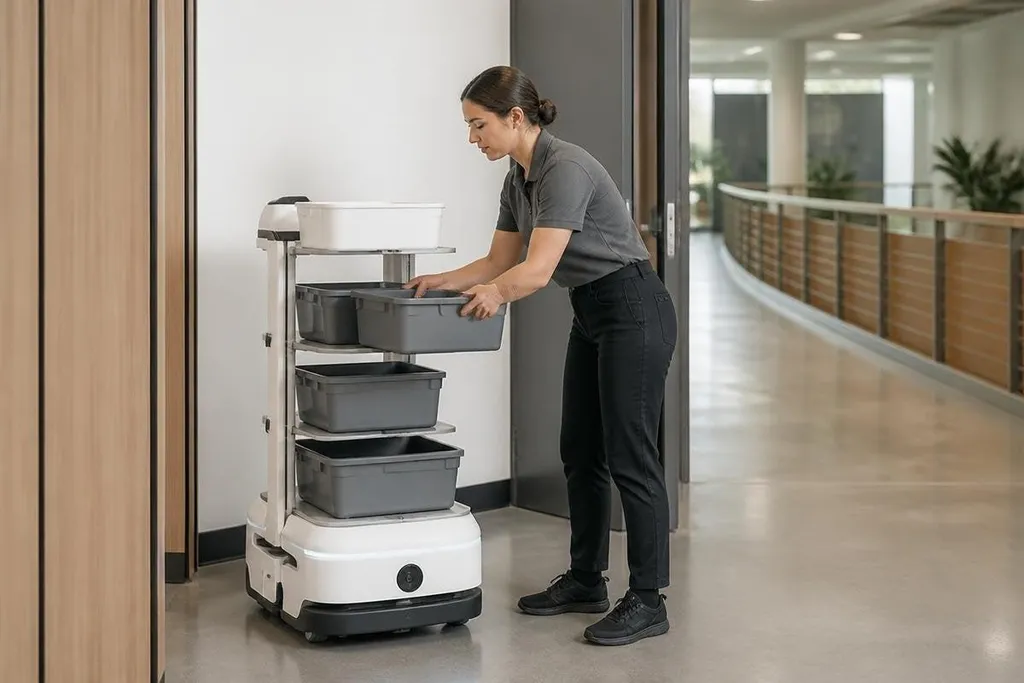
Service robots earn their place when they handle one repeat task that costs a business time or labor. The business case starts with that task, then works outward to price, safety, maintenance, and the people who will use the system.
Quick read
- Start with one repeat job, such as floor cleaning, delivery, inspection, or stock movement.
- Charge for a working service, not only for the robot hardware.
- Test the robot where doors, people, Wi-Fi, and floor surfaces can interrupt its work.
Find the job before the robot
A buyer rarely needs “a robot” as an abstract product.
They need a floor cleaned after closing, supplies moved between hospital rooms, trays carried through a hotel, or stock counted in a store. Each task has a place, a schedule, a failure cost, and a person who handles the work today.
That gives a new company a useful starting point. Watch the task, record how often it happens, and note what stops the worker from finishing it. A robot that moves well in an empty test area may still fail when an open door, a wet floor, or a customer blocks its route.
The first sale should focus on one job in one type of site. A narrow product is easier to price, install, explain, and repair than a machine that claims to handle every service task.
Where the money can come from
Robot makers can earn money in several ways, but each choice changes the buyer’s risk. A hardware sale asks the customer to pay at the start. A monthly fee spreads the cost and can include software, remote help, spare parts, or repairs.
A contract may fit better when the buyer cares about a finished task rather than ownership. The robot company could charge for cleaned floor area, completed delivery runs, or inspected rooms, but it then carries the cost when the robot stops.
The contract needs plain limits. State how many hours the robot can run, which floor types it supports, who moves obstacles, how quickly a technician responds, and what happens when the system misses a task. These details decide whether the fee matches the work.
Data storage, software updates, and spare parts can sit outside the monthly fee. A buyer comparing service robots can check service robot business reporting for named companies, machines, and costs tied to deployments.
The less visible work
The business sells more than motors, sensors, and a charging dock. It also has to map the site, connect to building systems, train staff, handle safety stops, and keep the machine working after installation.
That work can become a revenue stream. Site setup, fleet software, staff training, replacement parts, and regular service each solve a problem for the buyer. They also make the company responsible for the period after the first invoice.
Remote operation needs a clear place in the plan. A person may need to guide the robot around a blocked path or confirm a delivery. If one operator can supervise several robots, the company may reduce support cost, but that number must come from site tests rather than a slide deck.
What can stop the sale
Service robots work in public spaces, so the machine meets conditions that a lab can avoid. People change direction without warning. Elevators may need a building connection. A hotel can have thick carpets, reflective walls, and narrow service areas.
Safety adds more work. The buyer needs an emergency stop, clear robot behavior, records of faults, and a plan for staff and visitors. Local rules may also affect where the robot can run and what data its cameras or sensors collect.
The unproven part matters as much as the product demo. Ask for task results from a site that resembles yours, then check how often staff had to step in. A short video can show motion; it can't show the repair bill, the missed runs, or the hours spent clearing routes.
I’d start with a task that already has a budget, a repeat schedule, and a clear measure of success.
A buyer’s decision checklist
Use these checks before signing a pilot or service contract:
- Name the task: Write the exact work the robot will do and the hours when it must run.
- Set the measure: Pick one number, such as completed runs per shift or rooms inspected per day.
- Count human help: Record who loads, clears, guides, charges, and checks the robot.
- Price the downtime: Include missed work, spare parts, technician visits, and network faults.
- Check the site: Test doors, lifts, floor surfaces, lighting, Wi-Fi, and busy walkways.
- Define the exit: Set the date and result that allow you to stop, extend, or buy.
A service robot business has a real opening when it turns a repeated task into a paid service with known limits. The next proof is simple: run one machine through a normal week at one site, record every human intervention, and price the work from that record.